Sep 26, 2010

MARKET NEWS

Similarly, though less spectacularly, Tampines Court has seen a 36% rise in price in just 1 year.  This defies all the nay sayers in the last en bloc round who roundly predicted that TC prices would head no where but down. I predict $900k by Christmas.

.

Unit at Queens sells for $1,126 psf; Central Green hits $1,034 psf

Homes near MRT stations generally enjoy strong demand. For homes in mature estates with shopping centres and other amenities, demand is well supported — even in a quiet market.
One such development is Queens, located a short walk from the Queenstown MRT station. The 722- unit, 99-year leasehold condominium comprises three 39-storey towers. The eight-year-old condo along Stirling Road is near good schools such as Global Indian International School, Tisch School of Art and Crescent Girls’ School, shopping
amenities — IKEA, Queensway Shopping Centre and Anchorpoint — and car showrooms along Alexandra Road. Tan Jiawei, an agent with PropNex who specialises in this project, says the buyers are mainly local owner-occupiers. Tan also notes that Queens attracts HDB upgraders, as it is more affordable than other condos in the district, which typically command $1,300 to $1,400 psf.


Sep 23, 2010

MARKET NEWS

Guillemard Court up for en-bloc sale 

Guillemard Court, located along Geylang, Lorong 28, is up for an en-bloc sale.
The freehold estate has a land area of 31,684 square feet.
It has a plot ratio of 2.8 and can be built up to eight storeys.
The existing development is a four-storey walk-up apartment with 32 units
The indicative price of the land is S$33 million, which works out to S$360 per square foot per plat ratio.
Deans Realtors, the marketing agent for Guillemard Court, said the first advertisement for a public tender will be out on Thursday.
Source : Channel NewsAsia – 22 Sep 2010

Naung Court, a 20-unit development at Jalan Naung in the Hougang area, has been sold to developer Orion-Two Residential for S$28 million.
The 32,689 sq ft site is zoned for ‘Residential’ use with a gross plot ratio of up to 1.4 and can be built up to five storeys.
This works out to about S$662 per square foot per plot ratio if a development charge is payable.
To date, only one unit out of the 20 units has yet to sign the Collective Sale Agreement.
The marketing agent, Jones Lang LaSalle, said the site will yield a potential gross floor area of up to 45,764 sq ft, subject to approval and payment of a development charge of about S$2.3 million.
It could potentially yield some 43 apartment units with an average size of 1,000 square feet each.
Head of Investments at Jones Lang LaSalle, Stella Hoh, said she is encouraged by the strong interest in the site despite the recent property-cooling measures announced by the government.
She said the site’s convenient location – near Hougang Central and Hougang MRT Station as well as the Kallang-Paya Lebar Expressway – appeals to developers and home buyers.
Source : Channel NewsAsia – 20 Sep 2010

Another apartment is angling for an en bloc sale.
Owners of Glenville off Upper Serangoon Road are asking between S$38 and S$40 million for the property.
That works out to about S$715 to S$745 per square foot per plot ratio for owners of the 32-unit, freehold residential development located at Lim Tua Tow Road
The site spans 43,335 square feet with a gross plot ratio of 1.4.
It can be built up to five storeys, yielding a potential gross floor area of more than 60,670 square feet.
It is subject to a development charge of about S$5.3 million.
Sole marketing agent Jones Lang LaSalle said the site can yield some 57 units with an average size of 1,000 square feet each.
It added that Glenville is in close proximity to Serangoon MRT Station, the upcoming NEX Mega Mall and Serangoon Stadium.
The tender for Glenville will close at 4pm on October 5.
Source : Channel NewsAsia – 8 Sep 2010

Sep 13, 2010

Just Wait


Just wait; Tampines Court will follow because space and size are what matters most. As larger units become scarcer and scarcer, our value will increase - regardless of the fact we are 99yr leasehold. We will attract more permanent residents, more HDB upgraders who are looking for space for their growing families. The demographics of the estate will change and hopefully all the whingers and complainers will be replaced by positive owners, keen to make our shared property a nice place to come home to.

Sep 8, 2010

SHOEBOX UNITS

Lifestyles and Quantum price.. when will people realise they are being conned ...

Shoe-box units shrink median price of developers’ sales

About five years ago, studio units were about 500 sq ft; now it’s common to find 350-400 sq ft units. Two-bedders used to be around 900-1,000 sq ft; now they could be 700-800 sq ft,’ said the developer who declined to be named.
While this trend is not expected to fizzle out anytime soon, developers may move away from the shoebox model when more of these projects are completed, and if these tiny units do not quite achieve their touted high gross rental yields of 8-10 per cent, says Mr Ow.
Agreeing, the developer said: ‘It may not be so easy to resell these units when they are completed as buyers can actually see how tiny the apartments are. I think this phase of exuberance in owning tiny apartments will fade when they’re ready for occupation. When more shoebox apartments are completed, the supply will be saturated vis-a-vis the demand.’

Source : Business Times – 13 Oct 2010

Man who made ‘shoebox apartments’ a lifestyle to venture overseas


Sep 3, 2010

Luxury is SPACE

What defines a luxury property?

In attempting to describe the top category of residential real estate in Singapore, we often find ourselves struggling with adjectives. Before the Urban Redevelopment Authority came up with the term CCR (Core Central Region), we used to say “9, 10 and 11″ in reference to the prime residential postal codes. However, since the frenzy of the 2007 property boom, new terms have cropped up, such as super prime, super luxury, uber luxe, ultra luxury, etc.
Amid the slew of superlatives, Singapore lacks a clear definition of what a luxury property is, one that can be used as a benchmark by which others are measured.

What defines a luxury property?

Many characteristics can, in combination, define a luxury home. These would include location, price, size, furnishings, neighbouring homes, surrounding amenities, interior furnishings, layout, security, etc.

The top characteristic, in my opinion, would be location. If we are asked to name the Beverly Hills or the Knightsbridge of Singapore, we might think of Nassim Road, Ardmore Park, Holland Road, Paterson Road, Grange Road and Orchard Road, among others. If the same question is asked of the foreign investors here, Sentosa Cove, Marina Bay and Orchard Road might feature more prominently.

And within a prestigious neighbourhood, there are often streets that provide a distinction between those who have clearly arrived and those who are merely on their way.
A second characteristic is price or price per square foot of real estate. Knightsbridge, Sloane Street and Belgrave Square in London have been home to Britain’s most expensive residential real estate for the last 200 years and they will continue to lead because the richest people in the world own property there.

According to The Times of London, 14 out of the top 200 most expensive streets in Britain are in Knightsbridge. The world’s most expensive apartment is a penthouse at One Hyde Park, sold for £100 million or over £4,000 psf. That’s over $12,000 psf in early 2007, when the exchange rate was more than £1 = $3.

Singapore’s most expensive homes are in the Orchard Road area. They have been for the past three decades and I believe they will remain so for the next century. Any location elsewhere in Singapore trying to rival Orchard Road will merely serve to push up Orchard Road’s premium.

Economist and real estate investor Alex Shlaen, in the August 2009 issue of Property Report magazine, listed the Top Ten luxurious property projects in Singapore. Except for Sentosa Cove’s villas taken as a whole, and The Sail at Marina Bay, the other eight were condominiums in Orchard Road area.

Beyond location, Mr Shlaen’s key considerations were the condominiums’ furnishings and interiors and facilities. I think interiors and facilities are important factors but space and the immediate environment around a home rank higher on my list.

At the rate Singapore is developing, we are becoming more congested and might soon end up like Hong Kong or Tokyo. A very well decorated and furnished home, in the middle of a congested street where building-to-building distances are at a minimum, cannot be considered a luxury home.

Consider Sentosa Cove, where rows of detached houses stand side-by-side at 2m apart where the eaves of the roofs extend and 4m apart between the houses’ main structures. In most cases, this 4m space is separated by a perimeter wall. Compared to the luxurious space so evident in Victoria Peak in Hong Kong or even Kenny Hills in Kuala Lumpur, the streetscape in Sentosa Cove appears cluttered.

The sense of space gives the home a premium-space outside and space inside. Therefore, shoebox-sized apartments of 300-500 sq ft, even if built in a prime location, are not considered luxury homes.

The low price quantum for these units comes with a premium in terms of relatively higher dollar per sq ft prices, which may or may not be recoverable through higher unit rental rates and limited capital appreciation.

No matter where they are located – in New York’s Tribeca, London’s Knightsbridge, Hong Kong’s Victoria Peak or Singapore’s Orchard Road, these “prime” shoebox units are at best considered serviced apartments or hotel rooms, not luxury homes. Two- or three-bedroom apartments under 1,000 sq ft also fall into this category.

To sum up, the three most important characteristics of a luxury property are, in my view, location, price (quantum as well as unit rate) and space (both inside and outside) – all taken together.

So, for luxury properties, what are the three top street names in Singapore? My votes go to Chatsworth Road, Nassim Road and Bishopsgate. Think tree-lined boulevards, generous space between houses and blocks of condominiums, tranquility and, despite a high percentage of car ownership in these streets, traffic density is low. And, oh yes, crickets chirping, too.

By Ku Swee Yong, founder of real estate agency International Property Advisor.
03 Sep 2010 

Aug 31, 2010

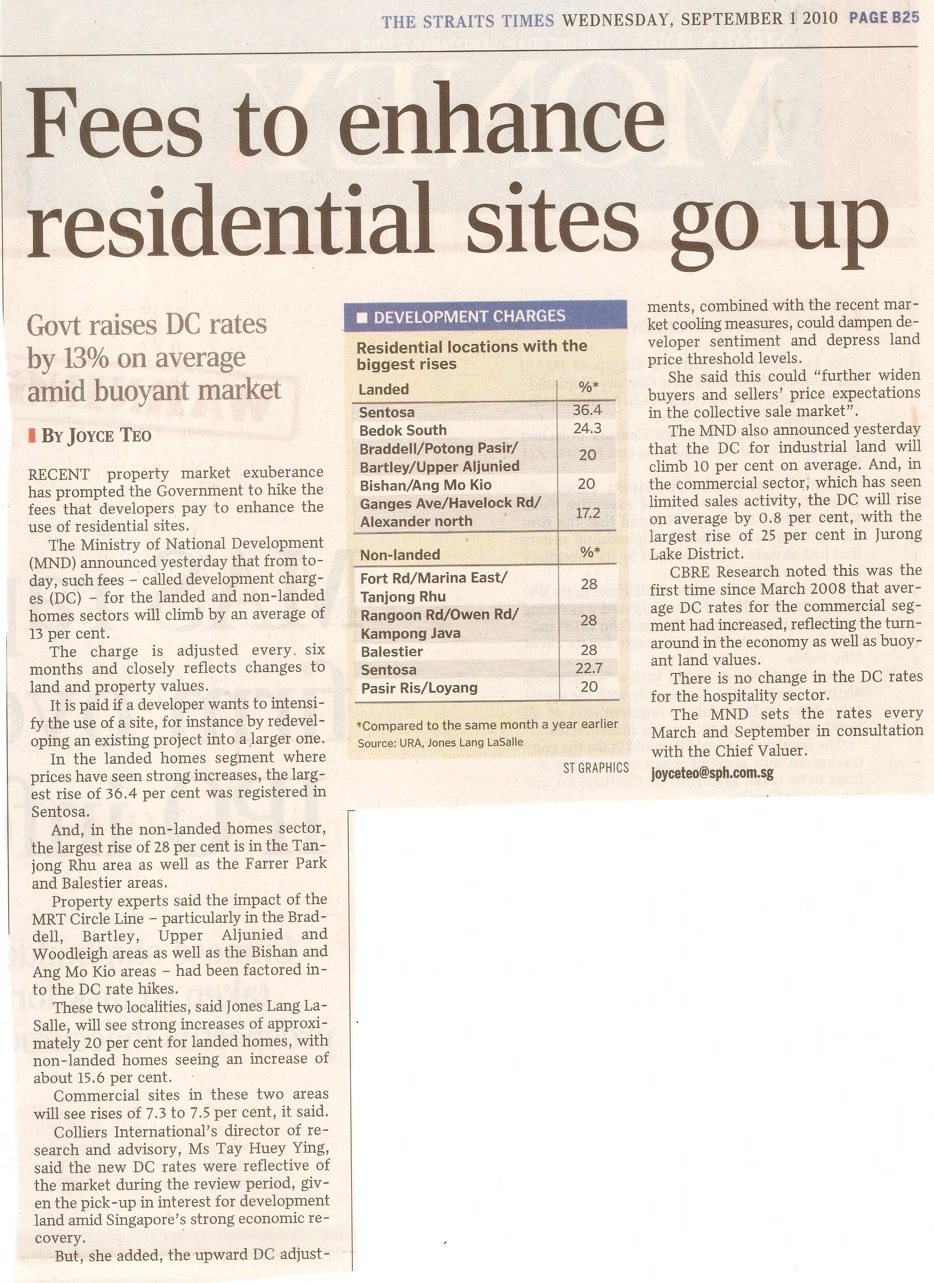
DC RATES SEP 2010

 
Chua Yang Liang, head of research, Southeast Asia, Jones Lang LaSalle, said: "The DC rates component in most en bloc deals is usually quite small. The component is just about 5 to 10 per cent of the total cost.

"But going forward, because of the policies that have been effected today, I think the level of collective sales may see a bit of a slow down going forward, where developers may take a wait-and-see approach before they embark on new purchases."


With regard to TC:


:

TOH TUCK APARTMENTS SOLD

TOH TUCK SITE SOLD FOR $34M

Property developer Roxy-Pacific said yesterday that its unit, Mequity, bought Toh Tuck Apartments in an en bloc deal for $33.9 million.
The freehold site, located at Toh Tuck Road, is the first collective sale in District 21 – which comprises Upper Bukit Timah and Clementi – this year.
The site has an area of 40,449 square feet, a plot ratio of 1.4 and can be built up to five storeys. A development charge of about $5 million is payable to redevelop the site up to a permissible 62,290 sq ft. This includes the 10 per cent allowance for balconies.
Together, the sale price and the development charge work out to $624 per sq ft per plot ratio.
Mr Jeffrey Goh, head of investment sales for the site’s marketing agent HSR, said about 75 apartments ranging from 590 sq ft to 1,660 sq ft could be built on the site.
“Toh Tuck Apartment is an attractive site, given its location in Bukit Timah area. It is within minutes of the Beauty World MRT station and close to good schools and amenities,” he said, adding a new apartment could fetch an average of $1,300 psf.
Source : Today – 31 Aug 2010

Effect on collective sales

How does this effect owners in collective sales? 


I suspect this will have a big effect on ex-HUDC estates that undergo collective sales, as the vast majority would probably have to downgrade to a HDB afterward due to the preponderance of sale committee and consenting majority ineptitude in these estates.

Well there are many kinds of owners with varying degrees of liquidity but all of them would now not be able to downgrade to a HDB unless they sell their private property within 6 months via collective sale or privately. I am not a lawyer, but I would assume, the collective sale would have to be STB/HC  approved and not just 'in the process'.

Since collective sales are notoriously long and uncertain, timing that HDB purchase is crucial and trickier now. Under the old system, owners who could afford to , just went out and bought a resale HDB at any time and waited for the collective sale to go through. They bought early to avoid the spike in resale prices in the area that surely would occur nearer the sale completion date. If the sale did not go through, they had 3 choices: a) just wait out the 3 year holding period before selling their HDB and move back into the private property (which they had rented out in the meantime). b) sell their private unit and stay in the HDB or c) keep both.

Now, if they bought the HDB too early in the process, they would be forced to sell their private unit before the sale's completion. Six months is not a long time to find a buyer, and depending on what point the collective process had reached, the seller could find himself selling at a steep discount from the RP. The buyer would naturally be a flipper - who else would buy.

For example:
If the CSA has been signed but not the S&P, then the seller has to price his unit so as the buyer can have a reasonable chance of making a profit when and if the sale goes through. Bear in mind the new owner would have to pay 3% sellers stamp duty for selling the property within 3 years to the developer-buyer. This new stamp duty is not the deduction stated in the Fourth Schedule  ('1. Stamp duty paid on the purchase of the lot or flat') and is not recoverable from the collective sale proceeds. The buyer can claim financial loss, though.

If the S&P has been signed, then it becomes even more difficult to sell the unit in the prescribed 6 month period unless at a steep discount.  The buyer cannot claim financial loss and so must make his profit from the seller's distress sale.... the MinLaw closed that loophole a long time ago. 

(c) shall not be taken to have incurred a financial loss by reason that the proceeds of sale for his lot, after such deduction as the High Court may allow (including all or any of the deductions specified in the Fourth Schedule), are less than the price he paid for his lot if he had purchased the lot after a collective sale committee had signed a sale and purchase agreement to sell all the lots and common property to a purchaser.

Do not be lulled into thinking that it is just a hop, skip and jump from signing the S&P and completion of sale. After the S&P has been signed, the sale committee has 1 YEAR to make it's application to the Board for sale, the Board has 2 months tops to mediate and the High Court is indeterminable. 

So unless, special consideration is granted to en bloc sales, buying that HDB before completion becomes a very risky business indeed. 

Special consideration? I don't think that will happen.


Aug 30, 2010

MND SPEAKS

MEASURES TO MAINTAIN A STABLE AND SUSTAINABLE PROPERTY MARKET
1      The Government announced today the following measures to maintain a stable and sustainable property market:
  1. Increase the holding period for imposition of Seller’s Stamp Duty (SSD) from the current one year to three years.
  2. For property buyers who already have one or more outstanding housing loans1 at the time of the new housing purchase:

    1. Increase the minimum cash payment from 5% to 10% of the valuation limit2; and
    2. Decrease the Loan-to-Value (LTV) limit for housing loans granted by financial institutions regulated by MAS to these buyers from the current 80% to 70%.
        The measures will take immediate effect on 30 August 2010.

2      The Government's objective is to ensure a stable and sustainable property market where prices move in line with economic fundamentals. The property market is currently very buoyant. While the rate of price increase of private residential properties has moderated in the last 3 quarters, prices have still increased significantly by 11% in the first half of 2010, and price levels have now exceeded the historical peak in the second quarter of 1996.

3      While Singapore has enjoyed strong economic growth in the first half of 2010, our economic growth is expected to moderate in the second half of the year. There are also still uncertainties in the global economy. Should economic growth falter and the market corrects, property buyers could face capital losses, with implications on their own finances and the economy as a whole. Moreover, the current low global interest rate environment will not continue indefinitely, and higher interest rates could have severe implications for buyers who have overextended themselves. Therefore, the Government has decided to introduce additional measures now to temper sentiments and encourage greater financial prudence among property purchasers.

Extending the Holding Period for Imposition of Seller’s Stamp Duty (SSD) on Residential Properties Sold from 1 Year to 3 Years
4      The Government imposed in February 2010 a seller’s stamp duty (SSD) for sellers who buy residential properties3 on or after 20 February 2010 and sell them within a year of purchase.

5      For residential properties bought4 on or after 30 August 2010, SSD will be imposed if these properties are sold within three years of purchase. Specifically, the SSD levied on residential properties will be revised to as follows:
  1. Sold within the first year of purchase, i.e. the property is held for 1 year or less from its purchase date – The full SSD rate (1% for the first $180,000 of the consideration, 2% for the next $180,000, and 3% for the balance) will be imposed.
  2. Sold within the second year of purchase, i.e. the property is held for more than 1 year and up to 2 years – 2/3 of the full SSD rate.
  3. Sold within the third year of purchase, i.e. the property is held for more than 2 years and up to 3 years – 1/3 of the full SSD rate.
        No SSD will be payable by the vendor if the property is sold more than 3 years after it was bought. Please see Annex for examples of how the SSD will be computed.

6      The extended SSD will not affect HDB lessees as the required Minimum Occupation Period for HDB flats is at least 3 years.

7      IRAS will be releasing an updated e-tax guide on the circumstances under which SSD will apply and the procedures for paying SSD. The e-tax guide will be available at www.iras.gov.sg. Taxpayers with enquiries may call IRAS at 6351 3697 or 6351 3698.

Increase the Minimum Cash Payment from 5% to 10% of the Valuation Limit for Property Purchasers with one or more outstanding Housing Loans
8      Previously, property buyers have to make cash payment of at least 5% of the valuation limit5.  With effect from 30 Aug 20106, the cash payment is increased from 5% to 10% of the valuation limit7.  This measure is applied only to buyers of private residential properties, Executive Condominiums, HUDC flats and HDB flats (including those under the Design, Build and Sell Scheme, or DBSS flats) who are taking housing loans from financial institutions regulated by MAS and who already have one or more outstanding housing loans at the time of applying for a housing loan for the new property purchase.

Decrease the LTV limit for housing loans granted by financial institutions regulated by MAS from the current 80% to 70% for Property Purchasers with one or more outstanding Housing Loans
9      The LTV limit is lowered from 80% to 70% with effect from 30 Aug 20108 for borrowers who have one or more outstanding housing loans (whether from HDB or a financial institution regulated by MAS) at the time of applying for a housing loan for the new property purchase.  Borrowers who do not have any outstanding housing loans continue to have an LTV cap of 80%.  These rules apply to housing loans granted by financial institutions for private residential properties, Executive Condominiums, HUDC flats and HDB flats (including DBSS flats).

10      Loans granted by HDB for HDB flats (including DBSS flats) will still have an LTV cap of 90%. HDB loans are offered to eligible first-time flat buyers and second-timers who are right-sizing their flats to meet their housing needs. They are required to utilise all of their CPF Ordinary Account balance before HDB loans will be granted.  Furthermore, those taking a second concessionary HDB loan must use the CPF refund and 50% of the cash proceeds from the sale of their previous flat before they are granted an HDB loan. This is in line with HDB's home ownership policy of helping eligible buyers, especially first-time buyers, purchase public housing in a financially prudent manner.
11      Financial institutions' lending standards have remained prudent and the asset quality of housing loans has stayed robust, with the non-performing loans ratio at less than 1% as at Q2 2010. Nonetheless, there are signs that more housing loans are originating at higher LTV bands of above 70%.  In line with the objective of ensuring a stable and sustainable property market, lowering the LTV limit sends a clear signal to financial institutions to maintain credit standards, and encourages greater financial prudence among property purchasers already servicing one or more outstanding housing loans.

Adequate Supply in the Pipeline
12      The Government will also continue to ensure that there is adequate supply of housing to meet demand. In the second half 2010 GLS Programme, we have made available sites that can yield about 13,900 private housing units, of which about 8,100 units will be from sites on the Confirmed List. This is the highest potential supply quantum in the history of the GLS Programme.  We will inject an even larger supply of private housing in the first half 2011 GLS Programme, if demand continues to be strong.

13      Apart from the supply from the GLS Programme, there are also 61,800 uncompleted units of private housing from projects in the pipeline as at 2Q20109. Of these, 32,600 units were available or could be made available for sale. These comprised units that had been launched for sale by developers, units that had pre-requisite conditions for sale10 and which could be launched for sale immediately, as well as units with planning approvals for which pre-requisite conditions for sale could be obtained quickly from the Government and made available for sale11.

14      The Government will continue to monitor the property market closely and will introduce additional measures if required later, to promote a stable and sustainable property market.
*****
1 Financial institutions are required to conduct checks with HDB and with one or more credit bureaus on whether the buyer has an outstanding housing loan at the time of applying for a housing loan for the new property purchase. For joint buyers, if either buyer has an outstanding housing loan, the joint buyers will be considered as having an outstanding housing loan.
2 This is in addition to the cash over valuation amount that has to be paid in cash.
3 The SSD will apply to the transfer or disposal of interest (including sale and gifts) of residential lands and residential units (whether completed or uncompleted).
4 The date of purchase for computation of the holding period for SSD shall be the date when a buyer (i.e. Buyer A) exercises the option to purchase the property, or signs the sale and purchase agreement, whichever is earlier. The date of resale of the property shall be the date when the subsequent buyer (i.e. Buyer B) exercises the option to purchase the property from Buyer A, or signs the sale and purchase agreement, whichever is earlier.
5 The amount of CPF monies plus housing loan taken for the purchase of the property cannot exceed 95% of the valuation limit (defined as the lower of property value or property price).
6 The 10% minimum cash payment will apply to transactions where the date on which the option to purchase (OTP) was granted falls on or after 30 August 2010; or if there is no OTP, where the date of the sale and purchase agreement falls on or after 30 August 2010.
7 Therefore, the amount of CPF monies plus housing loan that can be used for the purchase of the property will be reduced from 95% to 90%.
8 The 70% LTV limit will apply to transactions where the date on which the option to purchase (OTP) was granted falls on or after 30 August 2010; or if there is no OTP, where the date of the sale and purchase agreement falls on or after 30 August 2010.
9 These refer to new development and redevelopment projects with planning approvals, i.e. either a Provisional Permission (PP) or Written Permission (WP).
10 These refer to private residential developments with Housing Developer Licence and Building Plan Approval. Under the Housing Developer (Control and Licensing) Act, a sale licence must be obtained for a project with more than 4 units, if the developer intends to sell uncompleted residential units in the development. However, the sale of the residential units can only commence with the approval of the building plans of the development.
11 These refer to uncompleted private residential developments without pre-requisites for sale but with WP or PP granted. The sale licences could be obtained within 5 working days and building plan approvals could be obtained within 7 working days from the date of application for cases where clearances from various technical agencies are obtained and relevant documents are in order during formal submissions.
Issued by: Ministry of National Development, Ministry of Finance and Monetary Authority of Singapore
Date: 30 August 2010

Aug 26, 2010

Letter to the press

An en bloc rush, or just false hope?
Vibe on the ground doesn't match analyst optimism
Letter from Narayana Narayana
THE reports "Pasir Panjang apartment block up for en bloc sale" (Aug 24) and "Demand fires up en bloc market" (Aug 18) appear to portray the en bloc sale market in Singapore as strong and buoyant.

But is this really the case? Both reports are based on opinions of real estate agents, who arguably have a vested interest in keeping property prices perpetually on the boil.


A few weeks ago, The Sunday Times, in a glowing report "Signs of another en bloc rush", also reflected the optimistic views of a couple of property brokers who apparently specialise in en bloc sales. But in the same issue, its senior property writer sounded a more cautious note in the report "Selling en bloc? Big gains unlikely".


Where I stay, the chairman and secretary on an elected collective sale committee both sold their units within six months of the committee's formation, after they concluded that "the interest on an en bloc sale has yet to reach a level similar to our last en bloc attempt", according to the minutes of their meeting.


Given that this was their second bite at the cherry, they must have worked extra hard to get a good offer, but failed, leaving them to look after their own interests instead.


One cannot overlook the basic fact that all these projects will need funding, and an error in judging the strength of the market could trigger off a property crisis not unlike the sub-prime crisis America faced in 2008.


The optimistic confidence that "it wouldn't happen here" has been proved wrong on far too many occasions for us to continue to be sanguine in today's volatile conditions.
Today: Aug 26, 2010

I wonder  if the chairman and secretary were speculators to begin with; buying into the estate with the intention of starting an en bloc. Even if the en bloc did not materialise as they had hoped, their property values would have gone up due to the 'en bloc' factor and the present buoyant market, so jumping ship is always their second option. 

This leads me to my next point.  When a sale committee member resigns from the committee, there is no prescribed mechanism for him to be replaced. The LTSA is silent on the issue. Either the place remains unfilled or any Tom, Dick or Harry can jump in and take over. The owners have no say on the matter whatsoever. A position as important as chairman could theoretically be handed to the most unscrupulous person in the estate.

Unless owners stipulate otherwise what is to be done under such circumstances IN THE CSA

Do not accord the sale committee your full trust.  Do not assume they will prioritise your interests before their own.

In the end, when it comes to money, it is always everyman for himself.


Aug 22, 2010

Tampines Court AGM

Tampines Court's AGM passed yesterday without too much drama.

The usual non-attendance by the vast majority of residents.
The usual appearance of belligerent owners with personal grouses to air.
The usual questioning and eventual throwing out of resloutions which might have improved the estate.
The usual stony silence from reasonably minded SPs (bar 2 new owners).
No en bloc matters were raised - not that they could be - being the wrong venue and not in accordance with the LTSA.

Yep, par for the course, I'd say.

Aug 21, 2010

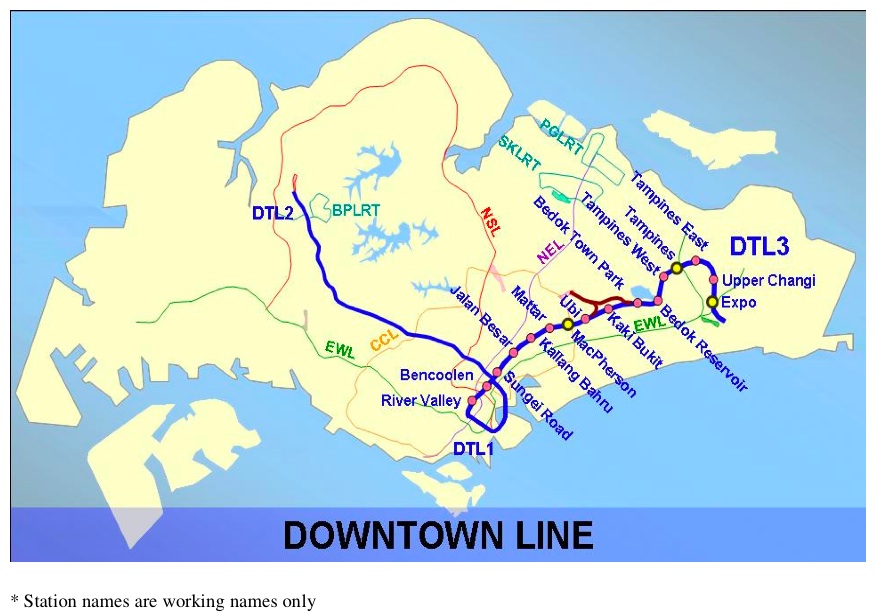
NEW MRT STATIONS FOR TAMPINES

Details of the eastern section of the Downtown Line revealed

Details of the eastern section of the Downtown Line are out, and residents of Tampines and Bedok can expect five more rail stations serving their estates.

But they may have to wait a little longer than planned, as the line will be completed in 2017.

The challenge of engineering works is one of the reasons given for the one-year delay.
Residents in the east will have another MRT line to town.

The eastern stretch of the Downtown Line is the final section of a 42-kilometre route linking Expo in the east to Bukit Panjang in the north-west, with a loop through Marina Bay.

From Expo, the train travels to Upper Changi, where the fourth university – The Singapore University of Technology and Design – will be built.

This is followed by five stations serving the housing estates of Tampines and Bedok.
The east is the most heavily-populated region in Singapore, and residents there will form part of the half a million commuters expected on the Downtown Line daily.

Sim Wai Chin, a resident of Bedok Reservoir, said: “”Every morning, I have to take the shuttle bus to Eunos MRT station to change the train to my office at Raffles Place. With the new line, it will save me a lot of time. I will not have to take the shuttle service, I will just take a train direct to my work place.”

The line continues to the industrial area at Jalan Besar station, via stops at Kaki Bukit and Ubi.

According to estimates by the Land Transport Authority (LTA), a person staying in Tampines and working in Kaki Bukit will take half the time to get to work. Instead of a 25-minute bus journey, it will take just a 10-minute train ride.

Jalan Besar station was not included in original plans, but was later added in view of future developments there, and to serve the existing industrial estates in the area.

The new Jalan Besar station will be located at the junction of Kallang Bahru and Lavender Road. The eastern stretch of the Downtown Line will run through areas that are quite heavily built-up, and for that reason, all 16 MRT stations will be built underground.”
Authorities are also expecting the budget for the entire Downtown Line to exceed the original S$12 billion target.

However, LTA declined to reveal estimates as tender for Phase 3 will only be called by the end of the year.

Lim Bok Ngam, acting chief executive, Land Transport Authority, said: “We have said it was indicative, because like any major engineering project, we have to work on the details. So when we went into details, fixed up the alignment, the stations, we find that more effort is required.”

From Jalan Besar, the train approaches the Clarke Quay area, served by River Valley station.

The train will then join the rest of the Downtown Line, which will open in stages from 2013. There will be 34 stations in all. Phase 1 loops through Marina Bay, while Phase 2 takes commuters along the Bukit Timah corridor.

Commuters can transfer to the Circle Line at MacPherson station, and to the East West Line at Tampines and Expo stations.

Apart from traffic diversions, some private land will also be acquired to make way for the line.

But authorities said they will minimise disruption as far as possible.

Transport Minister Raymond Lim said: “A certain amount of inconvenience is inevitable as we integrate our rail lines into our developed urban landscape. As far as possible, we will try our best to ensure that those living and working near the line will face minimal disruptions.”

Private lands that will be acquired to make way for the line include a Shell petrol station along Upper Changi Road, and two parking lots at Bencoolen House.
In addition, 15 landed houses along Merpati Road and Jalan Anggerek have been gazetted for comprehensive redevelopment as part of a policy to intensify land use around MRT stations.

The 2.7-hectare plot of land includes an adjacent 2.3-hectare plot of state land and is slated for a “high-density residential development”, which the Urban Redevelopment Authority said will be built after the completion of Phase 3.

Owners of the houses have five years to hand over the property, and will be given market compensation, in accordance with the Land Acquisition Act.
Source : Channel NewsAsia – 20 Aug 2010

Aug 20, 2010

MARKET NEWS

13 Jan 2011

NEWTON VIEW UP FOR COLLECTIVE SALE AGAIN

NEWTON View is up for collective sale again for the second time in less than six months - but with a slight cut in the asking price.

The owners of the district 11 freehold project are now asking for $150 million, slightly less than the $153-$155 million they were looking for when the site was first put on the market in August 2010.
Then, the tender closed with several developers submitting interest and bids but the reserve price was not achieved, said marketing agent Savills Singapore.

The new asking price works out to $1,302 psf per plot ratio (psf ppr), including an estimated development charge of some $582,000 and assuming a gross floor area of 115,737 sq ft. Newton View, at 26 Newton Road, sits on a 37,577 square foot site with a plot ratio of 2.8 and a permissible gross floor area (GFA) of 105,215 sq ft. Including an extra 10 per cent of space for balconies, the GFA can go up to 115,737 sq ft.

At the asking price of $1,302 psf ppr, the estimated breakeven is about $1,981 psf, Savills Singapore said. It expects the winning developer to be able to build a condominium with about 147 units averaging 750 sq ft each.
Savills Singapore executive director and head of investment sales Steven Ming said that since the property was last offered for sale in August 2010, the high-end market has picked up.

More transactions have taken place in recent weeks and several projects are enjoying good sales velocity, he said: 'This has sparked a renewal of interest among developers for prime sites and hence a decision was undertaken to launch the site for sale now.'
The tender for the site will close at 3pm on Jan 28.


ROBIN COURT AND ROBIN DRIVE BUNGALOW UP FOR COLLECTIVE SALE

15 units.  Plot ratio 1.4 Site area 40,518 sqft, GFA 63,606 sqf


Newton View up for enbloc
26, Newton Road, Singapore 307957 (District 11)
Indicative price of $153-155 million. Completion year 1982, Freehold, Apartment,  37,577 square foot site with a plot ratio of 2.8 and a permissible gross floor area (GFA) of 105,215 sq ft.

Two more en bloc sites up for tender 
Selegie Centre, a commercial-cum-residential building, is being put on the market with a guide price of $110 million to $125 million
TWO more collective sale sites are up for tender, and another two are in the works, as more homeowners attempt to cash in on rising property prices.
Selegie Centre - a commercial-cum-residential building - is being put on the market today with a guide price of $110 million to $125 million.
Located at the junction of Selegie and Mackenzie roads, the 9,729 sq ft freehold site houses a seven-storey block with 25 apartments and a five-storey building with 33 shops.
The marketing agent for the sale said that each owner of a residential unit can expect to receive at least $1.5 million, while shopowners will receive varying amounts, owing to the wide range in the sizes of the shop units.
As the District 9 site is located in a conservation zone, demolition of the building might be subject to the authorities' approval, but its commercial space can be partly converted and retrofitted to become a hotel or service apartments, according to Huttons.
Another marketing agent announced yesterday that the 15-unit Robin Court and an adjoining bungalow in Robin Drive have also been offered for tender.
The site's land area is 40,518 sq ft, with a gross floor area of 63,606 sq ft. It is less than 200m from the upcoming Stevens MRT station - part of the Downtown Line, expected to be completed in 2015.
Mr Karamjit Singh, managing director of the firm, said he believes this offering will be 'hot'.
He said the joint sellers expect offers of $66 million to $74 million, or about $1,046 to $1,172 per sq ft (psf), assuming that the remnant adjoining state land of 785 sq ft is purchased as well.
'At this price range, a developer may expect to break even at about $1,600 to $1,750 psf or so,' Mr Singh said.
The District 10 site, off Bukit Timah Road, is zoned for residential development up to a gross plot ratio of 1.4 and an allowable height of up to five storeys. The firm said the site can accommodate about 60 apartments with an average size of 1,000 sq ft, depending on layout and configuration.
The Straits Times also understands that Guillemard Court in Geylang Lorong 28, which has 32 walk-up apartments, and the 84-unit Changi Garden Condominium in Upper Changi Road North are expected to be put up for tender soon. Both are in the process of getting the owners' mandate of 80 per cent, and are confident of doing so.
- The Straits Times, 18 Aug 2010

Guillemard Court
Geylang Lorong 28, 32 walk-up apartments (80% still pending)


Changi Garden Condominium 
Upper Changi Road North (80% still pending)


Katong apts put up for collective sale
Amber Glades
63 units


Aug 14, 2010

BUONA VISTA GARDENS


Some en bloc shenanigans reportedly going on in this estate. Will try and get some details...

Comment from BVG owner:
An agent sent out 48 letters of offer to the 48 residents. A check showed that a developer-buyer is very keen on the land, and asked the agent to approach the owners. So it begs the question of whether the agent is working for the owners or the developer. But it is stated clearly in the terms of the "offer" that owners will have to pay 1% commission. There was no legitimate valuation to justify their offer price. Perhaps it was a ballpark price worked backwards from the amount of profits the developer-buyer hopes to get.

There are as many ways to circumvent the LTSA rules as there are to skin a cat. Not having to go through the collective sale process is the dream of developer-buyers and it is only possible in smaller estates with unanimous consent. 

Initially, I thought it was like an 'expression of interest' exercise; whereby if enough owners like the offer price then they would start the en bloc ball rolling for that developer.

But I now realise it's more like the  'hostile takeover en bloc' approach - the buyer will attempt to buy out the properties one by one, perhaps. See post below.

Golden Mile's Hostile Takeover attempt


Golden Mile owners try backdoor route to en bloc sale
Straits Times – 19th Sep 2009
.
Skulduggery, secretive investors, evasive property agents ... what a whole new angle this pseudo-en bloc is opening! This is a 'hostile takeover bloc' and should yield some questionable results. In effect, the owners would be selling the 'en bloc potential', so beloved by property agents, to one possible buyer who would then take on the mantle of bringing the process to completion. This 'possible buyer' could theoretically amalgamate all the units and either eventually own the whole complex or at least a controlling interest . The risk is enormous but the site's choice location could be the sway factor for them to even attempt such an approach. As with a listed company, a buyer could buy up a controlling number of shares (or share values in this case) and force an end result in their favour. Minority owners be damned! Bulldoze the lot over the edge as usual.
.
Of course he could also end up holding a large number of expensive units if the en bloc gamble fails for the third time.
.
The group is dangling exceptionally high reserve prices to tempt owners into selling.
Their plan is to pull together enough sellers to make up 20 per cent of owners in the two developments. The agent would then announce a public tender to sell those units jointly. Once a single buyer picks up all these units, there would be fewer parties to deal with when negotiating over a future en bloc deal.
.
My guess is it will not be much of a problem getting 20% to jump on the bandwagon early, as these owners would be selling their units on the open market at double the present market rate and would receive their proceeds in the same market as they sell - ie, they would not have to wait 2 to 3 years for the sale to go through the convoluted, statutory process of en bloc sale and find once again that their perceived windfall has turned into a pittance. Indeed they could very well garner 50% with this trick. But would they have to sign a mini-CSA amongst themselves, agreeing to a single RP? Probably not Since they aren't out to sell the estate, only their individual units, iand it isn't technically an 'en bloc'. and so wouldn't need to adhere to the LTSA rules regarding en bloc.
.
Point to ponder: Since no valuation on the entire property has been done (I presume), how can these owners be sure that even double the market unit price is a suitable en bloc price? An en bloc price is determined by doing a formal valuation on the entire property (taking into account the new plot ratio) and not just an individual unit market value. Is it enough to buy a replacement unit in the area? Of course, selling individually and under no pressure is infinitely preferable to a forced sale, so no tears split if it later transpires they undersold. But perhaps owners should get a proper valuation done - just to be on the safe side.
.
Unlike an en bloc sale, ‘we will not have any steering committee’, she said. ‘The agent talks to the owner direct.’
.
So it is NOT an en bloc sale!
But if the number garnered is anything less than 100%, then an application for sale has to be made to the STB in order to force the remaining units into selling. Only the STB has the power to take away individual property rights in this way. At that point, a sale committee has to be formed and it has to show it complied with the statutory requirements laid down in the LTSA. But the 80% had not been secured via the en bloc route and none of the statutory requirements were fulfilled.. so how?
.
The investor who ends up owning a major chunk of the developments, he said, could be held to ransom by other owners who might refuse to allow redevelopment to take place unless they are paid sky-high prices for their units.
.

'Held to ransom' or bargaining power - depending on which end of the telescope you are looking through. This is obviously a risk the investor would have taken into account before plunging in - so he cannot later cry foul on this matter. The buyer went on a buying spree hoping for a hostile takeover - and if his attempt failed then so be it- a gamblers loss only. By embarking on this route of sale, they are guaranteeing that there be no uniform selling price, another group of owners (who haven't sold out individually) might band together and feel just as justified for getting what they want for their units!
.
Other possible groupings a): single buyer securing 20%+1
b): 20%+1 of present owners wanting 1-for-1 exchange
c): 20%+1 of present owners wanting $2 million each (maybe after doing a valuation!)
d): 20%+1 demanding something else
Remaining owners are die-hard stayers who will take the matter to the STB
.
Conversely, that investor could demand a disproportionate share of proceeds in a future en bloc deal in return for his approval of the sale.
. 
So, the owners above who refuse to sell are holding others to 'ransom' (common blackmailers) and the investor-buyer doing the same thing is just 'demanding'! When the shoe is on the other foot, it seems........

Of course, I am assuming that the 'investor' is non other than the future developer and not just a consortium of investors looking to rape an estate and bring it to it's en bloc knees. I am sure there might be such consortium out there - a  group of rich boys pooling their resources and keeping their eyes skinned for small estates ripe for the picking. But GMC is too big for them, methinks, unless they are content with a smaller share.

Further ponderings:
.
If a single buyer (or a consortium) manages to secure 99% without a CSA and without forming a sale committee by mopping up individual units in the open market (in property agent arranged blocks of 20% or in dribs 'n drabs) - they would still have to form a sale committee and draft a CSA/method of of proportionment of sale proceeds and go through the motions etc before application for sale to the STB. Without 100% approval  LTSA rules apply. Everything can be done post-haste and there is no real need for  strict adherence to the statutory requirements laid out in the Schedules (there is no penalty involved if done in good faith).
.
After securing a large number of units for an sky-high price, can the 'majority' by share value then decide to state a lower RP in the CSA in order to attract more bids in an open tender or simply sell low to a private buyer? In other words, can the reserve price stated in the CSA be lower than the market price which had been previously set by the single buyer and can he sell cheap? Logically, why would he sell for less than he bought - unless he was selling the property to himself by proxy. Think NUS and GILLMAN HEIGHTS......
.
hmm...
What if the Valuation does not support the RP? Could the 'sale committee' (ahem) be then justified in selling the remaining minority units at a lower price psf?

What if the buyer(s) hold off and waits for the market to drop before forcing their hand and push the minority out with an offering of peanuts?

What if the majority shareholder takes over the MC and intentionally runs the estate down,
perhaps driving the resale price down, too?


What protection does the LTSA offer in such a hostile takeover of the 'share value' of an estate?
.
Since there is nothing collective about the sale via this route, it should not be allowed to proceed to the STB. Either the buyer secures 100% by this hostile takeover method or he doesn't. The LTSA should not be complicit in this kind of action ; shame on them if they are.

Aug 13, 2010

SPECULATORS

Recent launch prices for condos in outlying areas way above existing properties
The confirmation of the positive numbers for the private residential sector in Singapore for 2Q2010 appears to have unleashed another wave of buying onto the market.
From landed homes to HDB flats, the market is awash with liquidity. My colleagues in the appraisal department tell me that the rising prices for properties not matched by their valuations have not scuttled too many deals.
In the public housing market, higher cash-over-valuation (COVs) on top of higher prices have also not slowed the rise in the HDB resale market.
With so much cash floating around, I have often maintained that the market is always waiting for a good excuse to renew its buying activity.
That excuse was provided within the past two weeks. The Scala, a 99-year leasehold project near Lorong Chuan MRT station attracted hundreds of potential buyers – or over a thousand according to one report – that balloting was needed to sort out who got to enter the showflat first.
Of course, it helped that a private preview held earlier for Hong Leong staff and other buyers meant that about a third of the units had already been sold before the official launch.
The timing of the launch was also spot on as it came after more stations on the Circle Line from Bartley right through to Dhoby Ghaut were opened for public use. This meant that most residents in the area have already had experience using the new line.
Because the Circle Line serves mainly lower population density areas, there is less overcrowding on the trains. This means that most rides are much more pleasant than rides on the older North-South or East-West lines. To be near an MRT station is already a plus, but to be near the Circle Line is a bonus.
In the following week, the preview of The Greenwich condominium caused a rare traffic jam in the quiet Seletar Hills estate. The showflat closed at 2am the following morning in order to cope with the demand.
It has been a while since we saw such frenzied buying activity. Who are these people who stayed up to the wee hours after midnight to book a unit? Are we seeing the return of speculators to the market?
All the signs are there. On a per-square-foot basis, the reported average selling price of about $1,150 psf for The Scala is about 1.5 times the prices of existing apartments in the area.
One buyer was quoted as hoping for a 10- to 20-per-cent increase in prices within two years. This sounds reasonable, until you realise that he is already paying 50-per-cent more than for existing apartments in the area.
The jump in prices are definitely going to flow through into the third quarter private housing statistics.
The launch price for The Greenwich was at $980 psf on average, rising to $1,025 psf over the weekend – a record for a location so far away from the city centre.
One consultant was spot on when he was quoted as saying “the buyers are those who really like this corner of Singapore”.
Yes, it is really in one corner of Singapore. You need to own a car to live there or it can be pretty troublesome. Most residents in the area prefer living in houses rather than apartments. And the reason why they opt to live so far away from the city is because it is the only way houses can be affordable for them.
Why would someone choose to live in an apartment there when there are more than ample choices of apartments closer to the city with a better public transport network.
By any stretch of reasoning, I cannot see how owner occupiers can justify their purchases at these launch prices. It is also a little too much for investors.
That leaves the speculator, someone who plays the odds in the hope that it pays off and pays off really well. By their own reckoning, they need not depend on other Singaporean buyers. After all, the Chinese are coming. And they are known to pay big. Really big.
By Colin Tan, head of research and consultancy at Chesterton Suntec International.

Aug 12, 2010

Naung Court

Naung Court in Hougang trying for en bloc sale

Naung Court, a freehold residential development in Hougang, is trying for an en bloc sale.
The indicative price for the land is between S$28 million and S$30 million, which works out to about S$650 to S$700 per square foot per plot ratio.
A development charge of some S$2.7 million will be payable.
The site, located along Upper Serangoon Road, is 32,689 square feet in size.
It has a gross plot ratio of up to 1.4 and can be built up to 5 storeys. This will yield a potential gross floor area of 45,764 square feet.
Marketing agent Jones LangLaSalle said the site can potentially yield some 45 apartment units with an average size of 1,000 square feet each.
Naung Court is currently a 4-storey residential block comprising 20 units and within walking distance to Hougang Central.
The tender for the site will close at 3pm on September 14.
Source : Channel NewsAsia – 10 Aug 2010


THE collective sale market continues to gain momentum, with two freehold residential sites at Paya Lebar and Hougang up for tender.
Huttons is handling the sale of Charlesville, a five-storey 18-unit development at Upper Paya Lebar Road. Sixteen of the 18 owners have agreed to the sale and the asking price is around $31 million.
The site is 34,160 sq ft and has a plot ratio of 1.4. Charlesville’s existing gross floor area (GFA) is about 42,000 sq ft, but a developer can build a new project with a GFA of up to 52,600 sq ft, including an additional 10 per cent of space allowed for balconies.
A development charge of about $2.9 million will be payable. The tender for Charlesville closes on Aug 18.
Not too far away at Jalan Naung, the four-storey 20-unit Naung Court is also up for sale. Jones Lang LaSalle is handling the tender, and the indicative price is $28-30 million.
The 32,689 sq ft site has a gross plot ratio of 1.4 and can accommodate a five-storey project. The winning developer can build a project with a GFA of up to 45,764 sq ft, subject to payment of a development charge of around $2.7 million.
Naung Court is within walking distance of Hougang MRT station, Hougang bus interchange and Hougang Mall.
Jones Lang LaSalle national director and investments head Stella Hoh reckons the site will attract strong interest, pointing out that new residential launches in the vicinity have enjoyed good take-up rates.
For instance, in June, Kheng Leong sold 173 of 200 units launched at The Minton at Lorong Ah Soo. The median price was $871 per sq ft.
Ms Hoh said Naung Court site is a ‘good bite size’ for private investors, contractors and developers. The tender closes on Sept 14.
Source : Business Times – 11 Aug 2010

Aug 10, 2010

1-4-1-exchange

The pariah said:

Unless you are desperate for cashflow (ie, need cash immediately because of debt or health issues), a 1-4-1 en bloc exchange also offers an option for FUTURE CASH-OUT.


Example 1: After TOP of the redevelopment, the en bloc owner who opted for exchange could sell new unit in resale market. Whilst the property market may go further up or slide down between (i) en bloc vacant possession and (ii) redevelopment TOP, the risk is a calculated one based on the en bloc owner's market view.


Example 2: After moving back to the redevelopment and staying there for another decade or two, the en bloc exchange owner could then monetize a more valuable asset for eventual retirement whilst retaining the inflation hedge offered by such asset. Eg, by 2030, the value of a redevelopment on this choice location would have kept pace with inflation index.


If you know how to do your sums AND you are not desperate for immediate cash, 1-4-1 exchange would be a BETTER DEAL based on:

- (a) SAME floor level,
- (b) SAME strata title area, and
- (c) SAME geographic orientation of living room main window.


Terms and conditions for en bloc 1-4-1 exchange are documented in a BACK-TO-BACK Sale & Purchase Agreement (complete with architectural lay-out plan) BEFORE you sign the Collective Sale Agreement.


Think thrice BEFORE you agree to any en bloc offer because you stand to lose the crown jewel of your asset portfolio. No point crying over spilled milk afterwards.


As Homer Simpson said: "Beware of the power of stupid people in large groups!"

Aug 9, 2010

Letter from Hwang Yu-Ning Group Director (Physical Planning) Urban Redevelopment Authority
IN HIS Property commentary “Time to relook plot ratios” (July 30), Today editor-at-large Conrad Raj commented that the plot ratios in Singapore could be less restrictive and suggested that plot ratios should be raised for popular areas. The writer also queried the need to restrict the height of developments.
The URA agrees with the writer that land is a valuable resource in Singapore. Optimising the use of land is key to our land use planning. We want to assure Mr Raj that our general practice has indeed been to accord higher plot ratios to developments in locations within and near the Central Business District and near MRT stations.
Nonetheless, optimising land use does not necessarily mean that every piece of land should be built up to the maximum height and plot ratio. There are wider considerations when determining the appropriate plot ratios and height for a particular area.
Variation of plot ratio and building height is adopted to provide choices and confer character to an area. This is an important consideration to ensure a quality living environment for Singapore residents. For instance, providing a variety of housing types in terms of density mix gives people the choice to live in a high, medium, low-rise development, or in a landed home.
Together with our partner agencies, the URA takes a holistic perspective to ensure that intensification of land use is in tandem with the growth and the efficient use of our public infrastructure, such as roads and rail lines. We also ensure that development and intensification are not done at the expense of the quality of the living environment. Raising the plot ratios of too many land parcels in a particular area can lead to overcrowding and severe traffic congestion in the area.
The writer also noted that a development charge may be imposed on developers and architects who exceed the plot ratio stipulation in their designs. We would like to clarify that development charge leviable is not based on the plot ratio stipulation, but the enhancement in land value above the approved development.

What a load of rubbish! The URA does not give a toss about the traffic congestion higher plot ratios inevitably cause, and they certainly don't take overcrowding as a serious concern. They pile up the buildings, throw the masses together and 'tweak' the problems later on.